Thursday, 2 January 2020

Welcome back to 1943


The new year has come and gone. It was a quiet one at home, our town didn't have fireworks due to the fires around Australia and the drought we are currently facing. Many people feel like 1943 seems to be a long time ago, but if you look around there are still reminders of that time. How they lived then isn't too far removed from now, there were phones, cars, television, radios, and other modern cons. They were anxious and had sad moments of course, but they learn how to move on and made do with what they had. In today's time there are many who are trying to do the same.


As the world moves into 2020, I'm moving into 1943.  World War 2 is continuing and Australian households are facing a necessity to tighten spending habits to give money to war bonds and so that the government doesn't have to force people into harsher rations. Coupons are in full use for most items and many of the advertising of the day such as this ad for LUX washing powder encourages the use of being thrifty and taking care of clothing items so they last longer and coupons weren't used wastefully.


 Many of the articles in the newspapers are now talking about saving, being careful with money, and making do. The government of the time is asking people not to spend and instead find ways to put pursuits to wartime efforts instead. For those on the Homefront, that meant making sure the home was presentable and meals ready for those who were working outside of the home and doing late shift work for the war.


Many of the recipes of the day included very simple, quick, thrifty meals, for those who were watching how they used their coupons. All of this of course sounds very familiar as those of us who are doing it hard and trying to find ways to simplify, live simply, and spend less.


I'm doing my bit for the 'war', by using things I currently have and making the most of those items. I recently made a Christmas stocking from this thrift store brought cross-stitch kit I brought for $1. The stocking also used up fabric scraps I had.

This will likely be the major theme this year, to use what I have. The letter from 'Mauve Delphinium' is just one of many written in Jan, 1943 to Eleanor Barbour. The letter sums up the way everyone was helping with their bit for the war to save as much as they could. I am planning to show more letters of the time because they are  good example of what was happening in Australian Home-fronts.


As the war continues into 1943 the homemakers of the time are finding ways to be more thrifty to do their part for the war. This year, I will continue to follow along as they did, it may not be exactly the same as they live because I'm not trying to be a re-inactor. I'm trying to learn how they lived and take away parts I can use in my own life to make my life more thrifty too.


I hope everyone is having a good day or evening where ever you are.


Tuesday, 24 December 2019

Holiday cheer


DEAR “A PEACEFUL HOMEMAKER” READERS,

Today is Christmas day for us in the Southern Hemisphere and in the next week we will have New Year’s Day. Like my 1942 counterparts we are all wondering what the next 12 months will bring to us.   The last year has taught me many things as I attempted to live like 1942. It has taught me that I can do without luxuries which are considered necessities and unattainable during 1942.  Living like 1942 has taught me that I can manage with a limit to my clothes, sugar and tea. The 1942 ethic of Australian of the time has shown me they sacrificed a lot to help their country to save that country and its people. The Austerity living didn’t deter those to lend their bit to “Save their all”.


While researching the time period of 1942 I realise it had been a sad one for many. You cannot have war without sadness and 1943 will bring more of it as the war of the time goes on. 1942 reflects much of what is current today with most of us struggling on the homefront and times are hard.


 Even during the difficult times many of us are learning to live simply and make do like our 1942 folks. We are still keeping the home fires burning, preparing meals with less money, making do with less things, and hurrying to keep up with the housework while we also have jobs to do outside of the home.


Next year, no doubt, looks like it will be a continuance of the work of the last year, and perhaps even more intense. For myself, my vintage life will continue while I wait to go into my own home. I will continue this blog taking it now into 1943 to follow the homefront of the time to see how they continued to live under the hardships of world war 2. 

There won’t be another issue of  “A PEACEFUL HOMEMAKER” until after the New Year, so let me now wish you all the best that the year has in store, and a very merry holiday for Christmas day.


Have a good day or evening where ever you are.


Monday, 4 November 2019

Keep calm - Blog hiatus


I wasn't planing to place this blog on hiatus, but for now I know I have to while other more important things require my attention. Trying to maintain a home blog is impractical when you have to actually pack up and move into a new home! 

Our current place is up for sale and we made the decision to move on after nearly 4 1/2 years in this place. We could have resigned another lease but the thought of people coming in and out for house viewings, and on a month to month lease, wasn't an ideal way to live. So it is move we must. 

I sort of see it as keeping with my 1940's study as we will be with an Aunt until we find a place so I suppose you could say I've been billeted out as an evacuee, like Joyce ( in the book they changed her real name to suit the era. Her real name was Tracey) from the wartime kitchen and garden series! The hardest part is packing everything up for storage to only keep a few craft supplies out to keep me a bit sane. Obviously the crazy quilt is going to be worked on...who knows I may even get it finished in time for a new home.

So for now, I wish all my readers well and have a good day or evening where ever you are. Eventually I will resume blogging at a later date.

And here is a link to watch the Wartime kitchen and garden series.


Sunday, 29 September 2019

Letters from "Sour Grapes". The farm life quilt: 1942


While reading through the newspaper articles from 1942, I came across a request from "Sour Grapes'"who asked for the patterns of the farmyard quilt and I thought I would look through the archives to see if I could find those particular patterns.


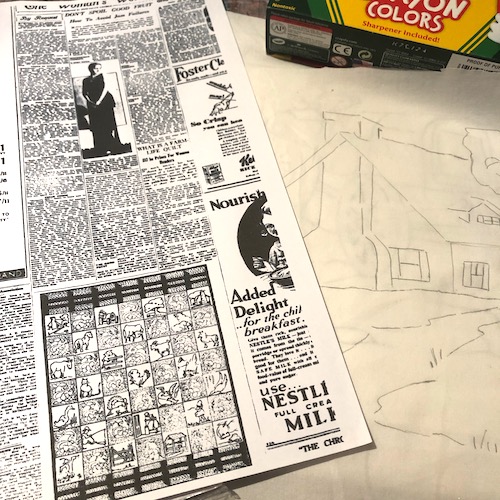
It took a bit of searching, but I did find it in older archives and I printed the entire set of patterns out.


Following the guidelines suggested for the quilt blocks I cut out my fabric. As every one now should be aware of, I do things frugally and these white blocks came from an old sheet. I'm planning to use the crayon tinting method to make up the blocks.


Each of the blocks in the quilt alternate with a cornucopia as the pattern. I'm thinking of making my alternate blocks crazy quilting as I have a lot of pretty cottons I can use on the blocks which keeps in with the 'make do and mend' of the era.


As you can see, "Knitter" replied to "Sour Grapes". The other quilt patterns "Knitter" mentioned I have also printed out and there is a three little pigs quilt too. All these were printed in newspapers from around 1932-33.


A lot of the patterns from the war era have always been knitting of some kind but  to see quilts mentioned is interesting and I am sure too there will be a lot more embroidery patterns available as this is when the tea towel and pillow slip embroidery came into fashion again.


I hope everyone is having a good day or evening where ever you are.

Wednesday, 18 September 2019

When there is no sugar, make a batch of scones -1942


Light Hands, Light Scones.

Scones are as simple as ABC to make. A proper scone maker will tell the first lesson for the cook who says they are never able to turn out a decent scone is to remember scones need lightness.  They are not like bread, where you have to roll and roll, and then knead and knead. And wielding flour will never turn out a fluffy scone. A good solid scone, maybe, but a scone that has lost all chance of lightness before it reaches the oven.


The secret of a scone is they must literally be tossed together, and quickly into the oven with a light hand (and light heart, too, if you can manage it), and the oven must be very hot. The whole process of mixing and cooking need only be around ten or twelve minutes.  

Scones are the next best thing to a cake that requires a lot of sugar and that they require very little in way of ingredients also makes it a top list for the wartime Austerity meal of 1942. Scones can vary in plain, sweet, or savoury.


A useful savory scone:

Add about half a cup of grated cheese to two cups of flour, you can also make up onion scones, which are tasty even if the name doesn’t suggest so. Here is the recipe:

Two large cups self-raising flower, 1 tablespoon butter, 1 cup grated cheese, 1 beaten egg, 1 small very finely chopped onion, 1/4 teaspoon salt, and about 1/2 cup milk. Sift flour and salt, rub in the butter and mix in the cheese and onion. Mix to a soft dough with the egg and milk, roll out and cut into usual shapes.
Bake about 10 minutes in a very hot oven.


I hope everyone is having a good day or evening where ever you are.

Tuesday, 10 September 2019

Vintage beauty

GLYCERINE AS A COSMETIC


It is worth knowing pure glycerine is valuable as a cosmetic . It has a wonderfully beautifying effect when used on the skin and as the benefit of whitening and softening any rough dry sky to make it supple. When using glycerine it shouldn’t be used as in a concentrated form. 

Glycerine has special interest for a beauty regime because of its property of softening the skin, but also for its capacity for fading discolouring, so that it acts a s a beautifier in the true sense of the word.  A tablespoonful of it in a  pint of water - or rosewater or, witch hazel- will soften and protect the skin from the air. It should be rubbed in, but not wiped off. 

Lotions containing glycerine agree with most cases of dry skin, and often combined with other beauty ingredients for wrinkled skin, blackheads, chapped lips, and sunburn. Pure glycerine has a powerful, beautifying effect on the skin.


Glycerine is a substance which may be used instead of oil and has the advantage of being more cleanly effective to the skin. It is more emollient than oil, and softens bodies without greasing them. A cupful in a bath of warm water will have a fantastic effect upon the skin of the body.

Glycerine having the property of absorbing water, uses up the moisture which the skin requires, and there-fore, should be diluted.

Those who want to try glycerine can do so by mixing in a little glycerine with the cold cream or lotion that they regularly use, but be sure to use only pure glycerine. 


To summarise, here are some of the virtues of glycerine:

1: It renders the skin soft, velvety, and supple.

2: It is an antiseptic.

3: It is the only cosmetic which softens without greasing.

4: It is more emollient than any oil.

5: It contains amazing preservatives qualities when applied to the skin, and acts as a veil against wind, heat, cold, and burning rays of the hot sun.

6: It has a tendency to dissolve blackheads and such.

7: It imparts to the skin softness, smoothness, and suppleness.

8:It is a great substances for curing chapped skin.

9: Used as a cleansing cream or lotion, it acts as a protector and beautifier.

10: It does not evaporate or dry out, nor turn rancid, nor decompose as almost cold creams do, and when added to them, prevents those preparations from doing so.

(Note: I used rosewater essence as I couldn't find true rosewater. And I didn't have fresh roses to make rosewater. You need to use quite a bit of the rosewater essence to make up for the substitute.)


I hope everyone is having a good day or evening where ever you are.


Monday, 2 September 2019

Foam Biscuits


We've had some lovely Spring like days here at the moment and it makes for nice weather to be into the kitchen cooking. I found this recipe called: foam biscuits, and thought I'd give it a try. 

The recipe it self is very basic and the original didn't give an oven time as I suppose they expected everyone to know how to bake a biscuit (cookie) in the type of oven they had. This was a time when people still had wood stoves and some had gas stoves and some had the new electric stoves.


FOAM BISCUITS:

Recipe: Take 3 cups plain flour. I cup of dripping. 1 cup of sugar. 1/2 cup milk, level teaspoonful Bi-carb. soda. Boil milk and sugar, then add soda and stir well. Let foam and cool. 

Rub dripping well into flour, add cool foam mixture and mix well. A cup of cocoanut can be added if liked. (I never added cocoanut to mine)

You can roll dough out and cut out with a cookie cutter or pinch off a piece of balled up dough and press down with a fork on a well greased baking tray. 

I baked mine in a moderate oven of 200 degrees for 15 mins or until golden brown.

Let cool  slightly on tray and turn out on wire rack to cool fully.

These biscuits can also be iced if you like. 


Because this recipe uses very little ingredients it was popularly added to 'Austerity recipes'. Although the war is still in early days and a lot of things have yet to be rationed and given coupons. Come December sugar will be rationed to 1 pound per person per week.

I have also seen this recipe in earlier newspaper articles as late as 1920's and right up to the '30's. It isn't a recipe specific to wartime cooking of the '40's, like say SPAM recipes of the time.


This is what the milk, sugar, and bicarbonate soda looks like when brought to the boil. The biscuits get the name foam biscuits from the fact the bicarbonate soda foams up.


The foamy mixture is then added to the flour and dripping mix and stirred up well. 


The finished recipe is a simple home style biscuit which can be fancied up with icing and sprinkles. If I had balled my dough up smaller I would have gotten a lot of biscuits from this recipe which makes it very frugal recipe.

I'm no cook, but I'm learning as I go and I think these are very easy to make.


I hope everyone is having a good day or evening where ever you are.

Wednesday, 28 August 2019

Austerity in the home -1942


My it has been a while since I last posted. With Spring approaching it is time to dust off the blog and start again. I’ve read a lot of articles and tried out many recipes while searching through the newspapers of 1939. The idea was to find out how they lived before the war and the restrictions on homemakers of the time. I used newspapers from Australia to get a good sense of what ladies (and possibly men) were doing during that time. Of particular interest were all the letters to Eleanor Barbour, the section gave a very good insight into homemaking and personal pursuits of the time.

As September approaches war will be announced and I have chosen that time to move on from 1939 and into 1942. I’ve specifically chosen this time as the Japanese bombed Darwin and suddenly the war that was over there, was now on our own doorstep. 1942 was a time when coupons were enforced and a call to Austerity was asked from Australia’s Prime Minister: Mr John Curtin. The call for everyone to do one’s part for the war began and this is the time when planting the garden for kitchen use was encouraged. 


Surprisingly a lot of words used for encouraging austerity in the home are in current use today: Simpler living, less spending, restricting unnecessary spending. As the Prime Minster said: “If you don’t stop spending we’ll have to ration everything.”

As I move into 1942, home life will have less choices and basic recipes will be back in use. The war meant many companies turned their factories over to war use and shop brought favourites were not available. This encouraged the use of home made, home grown, home baked, in many Australian homes.


The housewife of the time was asked to budget and find ways to cut back on spending. Many were told to share their ways of cutting back, saving time, and saving money. This all sounds familiar as I've been doing this all along and I know many who also do the same thing.


The home life of 1942, was all about making do with what you have and using basic home items to make the things you could not buy or should not buy. As one newspaper article wrote: It is about rediscovering the enjoyment of simple pursuits.


With the encouragement of the austerity campaign in homes of 1942, this was also the time when home gardening was requested. Flower patches were turned over to vegetable production and the encouragement of the victory garden began. With that in mind, my own garden is undergoing a change to the 1942 gardens of the time.

This era feels very familiar and I am sure it will be to many others who follow a simple, frugal, life.


Below is a video of Prime Minster John Curtin encouraging all Australians to be useful during the war.


 I hope everyone is having a good day or evening where ever you are.


Saturday, 18 May 2019

40 vintage ways to cut costs


Vintage living is renowned for having a life-style based on frugality. Adapting the rules from a no-nonsense era can stretch today’s dollar and cut household costs. 
As I continue the year of living like 1939, I can hardly be anything less than a careful housekeeper. The suggestions that follow are all I have learnt so far.


1. Grow as much food as possible to lower the food bill, and freeze or can what you can’t use immediately. Even tomatoes can be frozen and used in soups and stews.

2. Save leftovers to make potato scones, soups, stews or fried vegetables.

3. Sheets can be reversed to extend their wear, putting the top border at the bottom end of the bed.

4. A sheet that’s worn in the centre can be put “sides-to-middle.” Cut it in half lengthways, seams the sides together and hem the raw edges.

5. Turn back bedding in the morning to help keep sheets to stay fresh longer. Which will cut back on frequent laundering. 

6. Cleaners should be bought in the most economical size (not always the largest) and decanted into spray bottles. Use just a squirt instead of pouring out a large amount.

7. Don’t use more laundry detergent than you need. If you don’t have a measuring cup, use a 470g jam jar (fill it halfway for a cup measure).

8. A slightly soiled wash may not need as much detergent as the manufacturer recommends.

9. Towels need watching. At the first sign of weakening along the edge, take bias tape and sew it with strong thread on both sides. 

10. A ripped towel can be cut into squares for use as washcloths.

11. Worn-out towels, cut into squares and bound together in four or five thicknesses, make good washable pot holders. Hem with binding tape and leave a piece at the end to make a little loop of tape to hang them up.

12. Wash blue towels, sheets, pillowcases with your whites to brighten up the white wash. Of course, any new coloured items should be washed separately for a few times.

13. Camouflage unremovable stains on children’s clothes with embroidery. Paint, rust spots, small rips can all be concealed with stitched flowers, a butterfly or a fish, using washable beads or old pearls for centres and eyes.

14. Soap is said to harden with keeping. Buy it six months ahead and store. unwrapped, in the linen cupboard. It smells good too.

15. Use soap holders to prevent soap being wasted.

16. If your bath oil label suggests using two capfuls, then half a cap is probably just as good.

17. You can get rid of paper table napkins, too. An inexpensive bangle for a serviette ring for everyone in the family and a hemmed square from a worn-out towel make free substitutes.

20. Scrub the dirtiest spots on clothes first to cut down on the washing time.

21. Boil only enough water for the cups of tea or coffee needed.

22. Have everything ready before the kettle comes to the boil, turning off the heat as soon as the water is boiling.

23. Use the minimum amount of water to cook vegetables. Add a tablespoon of water and a dab of butter to the vegetables, shake to coat, then cover and cook slowly.

24. A properly insulated oven retains heat. Turn it off before dishes such as casseroles are quite ready.

25. If the oven is already on, cook frozen vegetables in it. Put them in a covered casserole with a little water, butter, and salt, and cook for 39 minutes.

26. Keep your mending up-to-date, or that pair of ripped pyjama pants will sit in the mending box until it’s been out-grown. Organise a mending or sewing circle among your neighbours, for one or two afternoons a month.


27. Worn-out clothes should have zips, buttons and binding tape removed. The old binding is more suitable for mending older clothes, since new tape is stronger and causes more stress. 

28. A patchwork quilt uses up old clothes. Make a cardboard template about 20cm square, and cut squares from the better parts of old garments. Back the quilt with an old flannelette sheet and interline with an old swollen blanket. Pillow slips can be fashioned in the same way.

29. Short dresses can still be used by buying or making a wrap skirt in a complementary colour to wear over the dress.

30. Lengthen accordion-pleated skirts using a remnant of fabric lining. Unpick the waist. Make a circle from the lining by seaming together a strip 17 cm wide and hop measurement plus 5cm long. Stitch the circle tot he top of the skirt - this portion will be hidden by an overblouse or seeker - and make an elasticised waist.

31. Hand-knitted sweaters are warmer and can be unravelled when outworn or outgrown. Wind the yarn loosely around a large book, tie the skein in several place and hand-wash.

32. Sometimes there is enough fabric in a pleated skirt to make into another garment by unpicking and pressing out the pleats. The material can then be reassembled.

33. Carry a notebook with your family’s current measurements. If you see an unexpected sale, you’ll be prepared.

34. Jot down metres or wool requirements for a pattern. That way you won’t buy too much or too little.

35. Thermal cot blankets can be saved and seamed together to make a bedsize blanket when the cot is outgrown.

36. Bean sprouts are an excellent and cheap source of vitamin C. 

37. Worn-out sheets cut into handkerchief-chief size pieces are softer on the nose than tissues.

38. Conserve heating oil or gas by keeping the thermostat about 19 deg C (66 deg F) during the day and turning it down at night. Better still, turn the heat off.

39. Cook roast beef slowly to minimise shrinkage. Rub it with oil but no salt, and place on a rack in a shallow pan fat side up. Do no sear or add water. Cook, uncovered, in a preheated 150 deg C (300deg F) oven for 32 to 34 minutes per 500g (1lb) for medium.

40. A clothes dryer can use up to 100 kilowatt hours a month; drying clothes on a line is free. Clothes can be partly dried in the dryer, then hung on a line under cover.


I hope everyone is having a good day or evening where ever you are.


Friday, 10 May 2019

IN YOUR GARDEN


In the Southern Hemisphere, Australia is in autumn heading into winter, and the winter chill is very much here. For the garden the newspapers of 1939 say it is time to sow beds where plants such as quick-growing annuals are needed. Popular flowers during the era for planting now, include:


* Virginia stocks (for ribbon borders)
*Larkspur
*Dwarf nasturtiums
*Shirley poppies
*Gyspohilia
*Candytuff
*Petunias
Nemesia, snapdragons, and sweet peas.


Hardy annuals should be sown in boxes or seedbeds for late flowering seeds. 


Now is a good time to make speciality of bedding out pansies, violas, stocks, Iceland poppies, carnations, lobelias, linaria, English daisies and calendula. All root cutting of pelargoniums should be done now.


In the vegetable plot sow or plant cabbage, cauliflower, kale, kohl-rabi, parsnips, turnips, silver beet, herbs and broad beans.

Strawberries should be planted out in proper containers or beds.


ROOM REQUIRED


Every vegetable planted needs ample room to be able to grow into flourishing plants. Carrots, turnips, parsnips, and red beet should be planted from four to five inches apart. Seeds need to be thinned out from six to ten inches apart with a foot between rows. For general purposes onions will do well with four inches apart, with ten inches separating the rows; lettuce will need a foot apart and twenty inches will do for cabbages in rows two feet apart.


I hope everyone is having a good day or evening where ever you are.